OhMyGame is a project our team recently open-sourced. We describe it as an “open-source one-person AI game studio.” After the user describes an idea, the agent designs the game, generates the assets, and then builds and tests it.
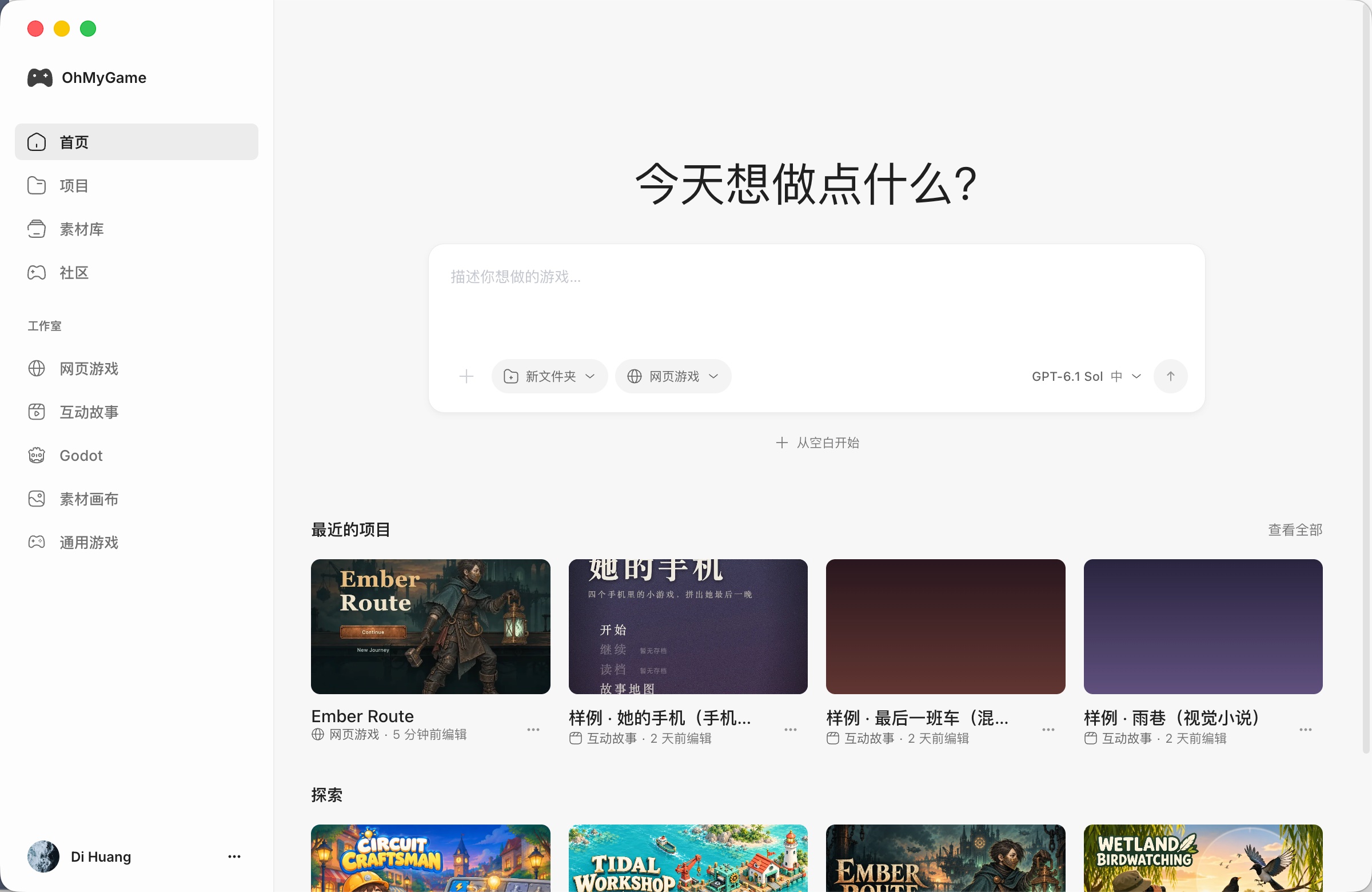
Our core innovation is bringing the Canvas and the whole game workflow together, so the development process is simpler, clearer, and more intuitive. As far as we know, OhMyGame is the first game agent in the world designed around a Canvas.
We are a small team with no built-in audience. In the first 10 days after open-sourcing, OhMyGame got 936 stars, and I want to write down where that growth came from and how the launch went.
The conclusions first:
- In 10 days we got 936 stars, shipped 11 releases, and merged 131 PRs.
- The main growth channel was X. X alone brought more people than the next four channels combined.
- We did not pay for any promotion this time. Nearly 1,000 stars came mostly from content spreading on X.
- GitHub has some traffic of its own, but it is very limited.
- We fixed user issues quickly. Most requests shipped within a few days, and the fastest bug fix took 37 minutes.
Here is the star curve for these 10 days:
Numbers and traffic
Beyond the numbers above, there were also 113 forks in these 10 days. The 11 releases went from beta.3 to beta.4.9, roughly one a day. Users opened 36 issues, and 26 of them are already closed.
To see where the attention came from, I looked at GitHub's traffic data for the repo. There were 3,648 visitors over these 10 days, and the main sources were:
- X1,19453.7%
- GitHub35916.1%
- ohmygame.ai32614.7%
- Google2089.3%
- V2EX1386.2%
X brought 1,194 visitors, about 54% of the top five sources in the chart. Most of that came from two posts of ours that did well:
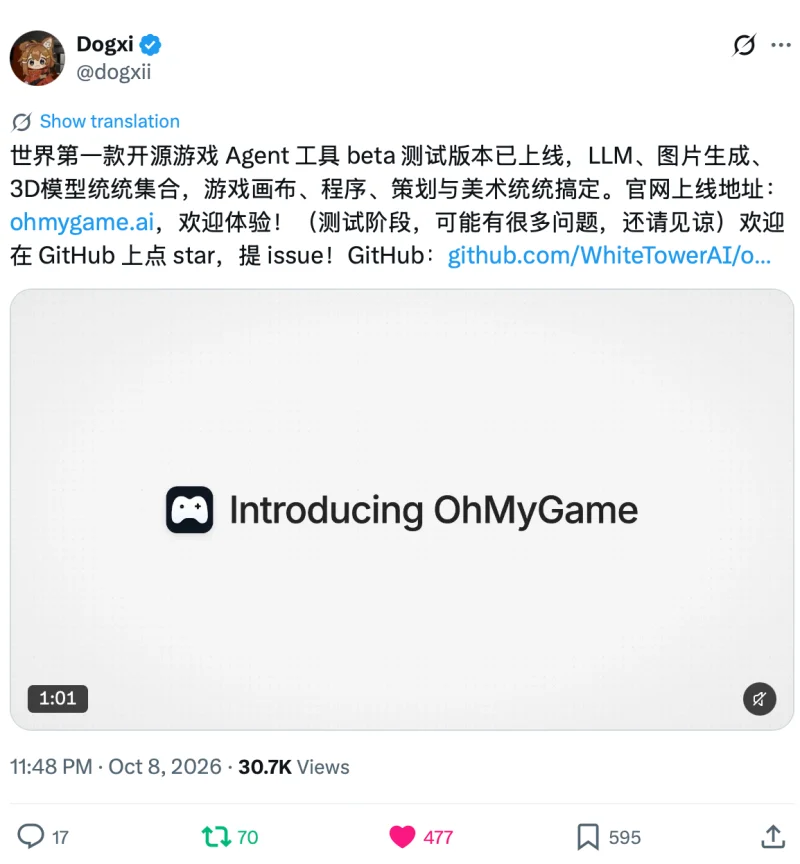
- The launch post. A little after 11 pm on the night we open-sourced, our teammate Dogxi posted an introduction, which now has 30K views. Not much happened at first. It only started to climb around 7 am the next morning, and by the evening the repo had gained about 300 stars. Most of the first day's stars came from this post.
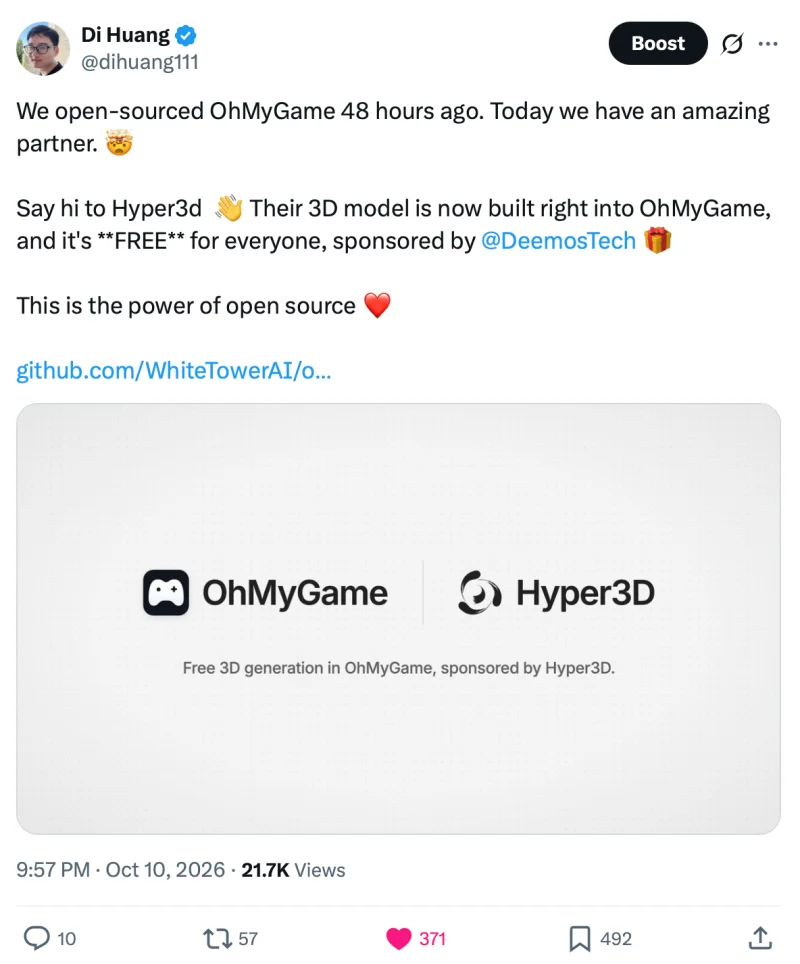
- The Hyper3D collaboration post. I posted this on the evening of the 10th, and it now has about 22K views. The likes kept growing, and the repo gained about another 180 stars the next day.
After the 16th, star growth slowed down: 48 stars in three days.
Responding to every request right away
We try to respond to every user request right away, and to ship the feature or fix the problem as quickly as we can.
Chinese interface. Someone asked for a Simplified Chinese interface (#134), and it shipped 3 days later in beta.4.7.
Undoing a round of agent changes. Someone wanted to roll back when the agent broke something (#202). beta.4.9, released 4 days later, supports this: after each round, the agent lists the files it changed, and the user can undo them in one click.
A bug on Windows. Someone reported that the example projects could not be remixed on Windows (#122). The fix was merged 37 minutes later and went out the same day in beta.4.2.
What users made
Q&A
Why build an AI game tool?
This came up in many of my private chats with users. My background is in 3D vision and graphics, and I have always wanted to do something related to games. After building the previous few apps, I really felt that you have to build something you have a “feel” for. Without that feeling, it is hard to keep going, and hard to do it well.
Why open source?
There are some distorted business models in AI right now, where a lot of AI apps make money from users through information asymmetry. It is a kind of bad money driving out good: good, cheap products often lose to products with better marketing, and users end up paying a large marketing premium.
We chose open source because we want people to be able to create in a cheaper and simpler way. We do not want to make money from the information asymmetry that comes with AI moving fast. We would rather build a long-term friendship with our users. I will write a separate post about this later, on our vision.
What's next
Connecting the Codex and Claude Code CLIs. Our agent is built on Pi, and you can sign in with a ChatGPT or Claude subscription. But many users told us this has a lot of problems: for example, you cannot generate images after signing in with a ChatGPT subscription, and signing in with a Claude subscription requires turning on usage credits in Claude separately, with usage possibly billed against those credits. So we are looking into connecting the Codex and Claude Code CLIs directly, so that people with those two subscriptions can use OhMyGame more easily.
Improving interactive stories and plugins. Many teams in China making interactive film games have been talking to us about this, and interactive narrative has broad demand in general. This week we will do a focused round of support for this kind of game.
More: multiplayer games, Unity and Unreal support, more creative workflows, and so on.
Thanks
Thank you to everyone who starred the project, and to everyone who opened issues and PRs and contributed to it. Thanks to Hyper3D for sponsoring us right away, so users can try state-of-the-art 3D generation. And thanks to our investors, who gave us some very good suggestions on where to go next.
If you have run an open-source project too, I would love to hear how you kept the momentum going after the first week. Come find me on X.