
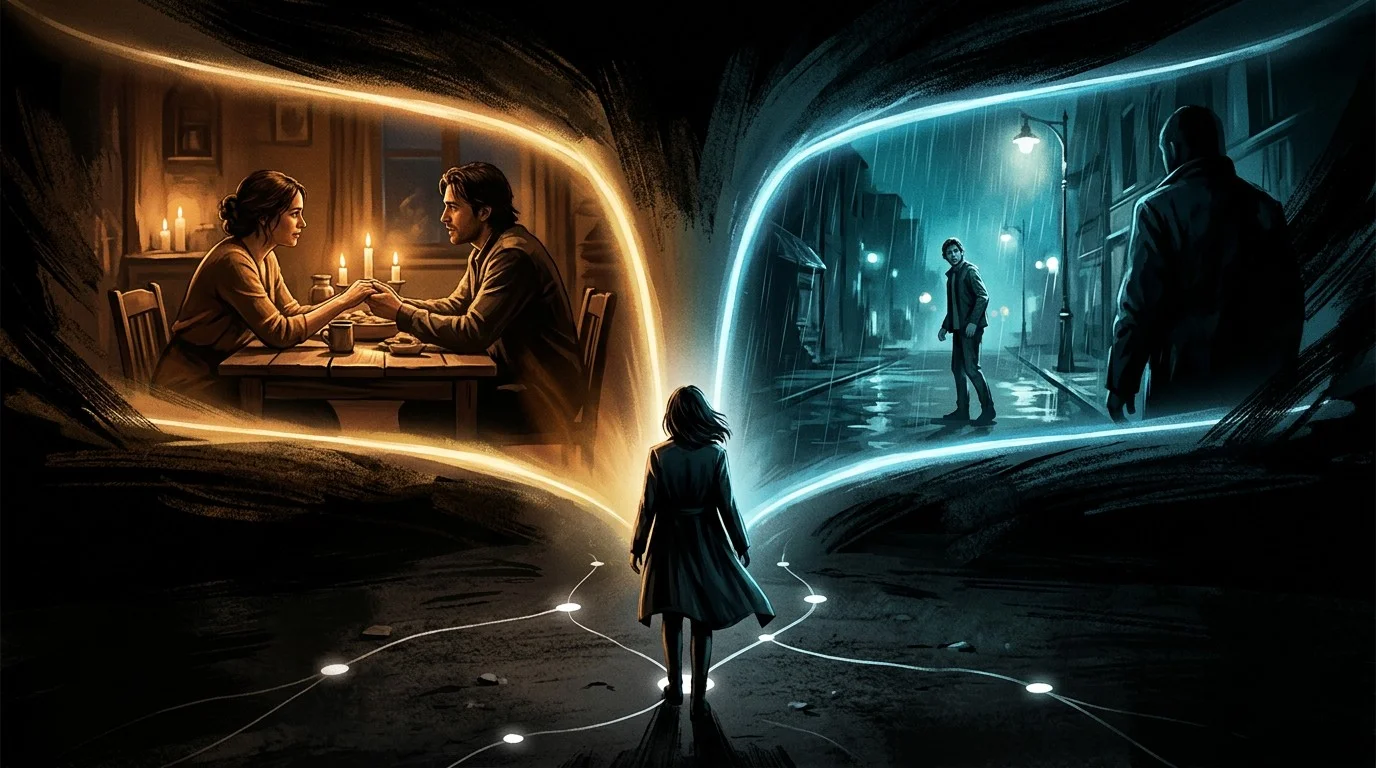
AI interactive drama can be seen as an extension of AI-generated short-form drama: video and storytelling remain at the core, but viewers can make choices at key moments and influence what happens next.
Interactive video is not a new concept. Around 2020, the success of The Invisible Guardian led major Chinese internet companies to view it as a promising content format. But after the initial excitement, it never became a mainstream consumer category.
Today, it mainly survives in two forms:
- Interactive videos on Bilibili;
- Interactive games on Steam.
Most Chinese studios focus on Steam because it offers a clearer path to monetization. Interactive videos on Bilibili, by contrast, are often passion projects. More branches require far more content, but the additional effort does not translate proportionally into views or revenue.
Why Interactive Video Never Truly Took Off
The core problem was simple: production costs increased substantially, while the experience did not improve equally for most users.
Interactivity remains a relatively niche demand. For many types of content, people would rather watch a complete, uninterrupted story. As a result, interactive video often needs to be sold as a game on Steam to justify its higher production cost.
In other words, it has historically been constrained by both expensive production and limited demand.
What AI Changes Is the Supply Side
The key change brought by AI is a significant reduction in production costs.
AI interactive drama is still more complex than a regular AI-generated short drama. But when scripts, storyboards, and videos can all be generated with AI, creating multiple branches no longer requires multiplying the cost of actors, sets, and production teams. The largest barrier that once constrained interactive video is beginning to disappear.
This does not mean interactivity will become a universal need. But it can meaningfully improve certain genres, especially mystery, horror, and romance. In these stories, choices are not merely an extra feature—they are part of the experience itself.
What an AI Interactive Drama Product Needs to Solve
At the level of individual shots, AI interactive drama is not fundamentally different from AI short drama. Each shot can already be created on platforms such as LibTV.
What makes it different is how story nodes, user choices, and video clips are organized. The product therefore needs an editor designed specifically for branching narratives.
More importantly, it should automatically generate the story structure, choices, branches, and corresponding videos, covering the entire workflow from story generation to publishing. Otherwise, AI only reduces the cost of individual clips without solving the complexity of organizing them.
The Missing Platform
Outside China, interactive dramas are largely distributed as games on Steam. There is no widely adopted platform dedicated to creating, discovering, and watching this type of content.
This is an opportunity, but also a major challenge. A dedicated platform could offer native interactive playback, content discovery, publishing tools, and monetization. It could make interactive drama feel like a distinct content category rather than a niche form of video game.
However, building the platform also creates a cold-start problem: creators will not join without an audience, while viewers will not stay without enough high-quality content. The opportunity is therefore not only to build an AI creation tool, but potentially to establish the distribution platform and content ecosystem around it.
Is This a Product Opportunity or a Technical Opportunity?
In the near term, AI interactive drama looks more like a product opportunity than a technical one.
Most of the underlying generation capabilities already exist. The task is to turn them into a complete and accessible production system, then use the current window to validate real demand. Competition will likely center on product experience, content workflows, and distribution rather than foundational models.
The product is also aimed at mainstream creators rather than the technical AI audience on X. This is somewhat different from my own preference for technical exploration, which is one reason I remain uncertain about the direction.
From Pre-Generated Branches to Real-Time Generation
Today, an interactive drama is still essentially a pre-generated story tree. Creators produce every possible segment in advance, and viewers choose between existing branches.
If video generation becomes fast enough, the system could generate what happens next in real time based on the viewer’s choices and the current state of the story. The experience would no longer be limited to a fixed number of branches. Instead, the story could become an open space that continues to evolve.
This capability would extend beyond interactive drama.
- In story-driven products, it could enable more open-ended, nonlinear narratives.
- In chat and virtual-character products, it could turn text conversations into real-time video interactions, making companionship, emotional experiences, and adult content far more immersive.
The near-term opportunity for AI interactive drama is to use AI to revisit a market previously constrained by production costs. Its long-term potential is to let stories evolve in real time around each individual user.